
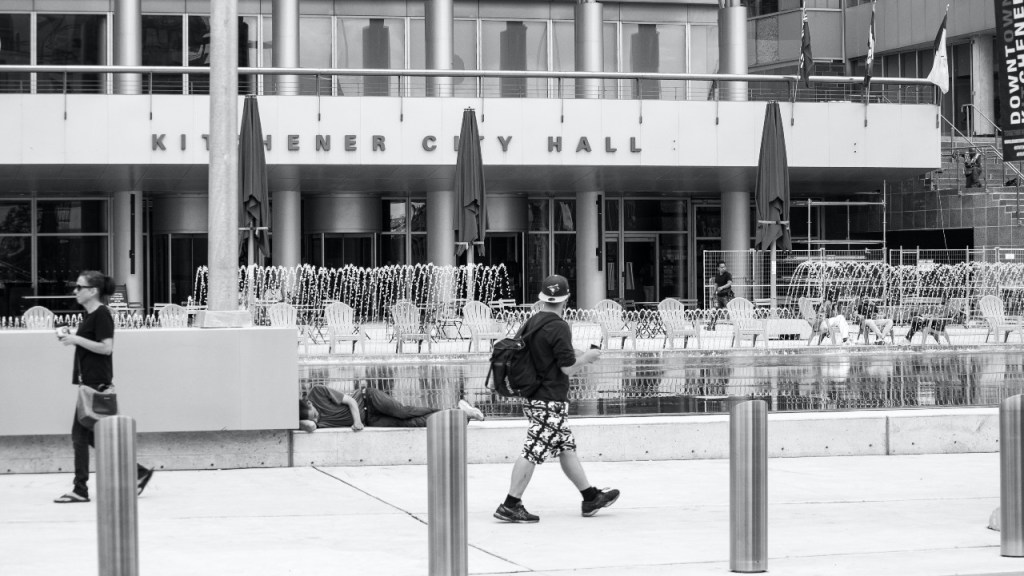
Before the First World War, Kitchener was known as “Busy Berlin”.
It was over six years ago when I first had the idea of doing a podcast about diversity in Waterloo Region.
At the time, the Syrian refugee crisis captured the world’s attention and Canadians were divided over a federal plan to accept tens of thousands of refugees into the country. Many eventually settled in Waterloo Region.
I was struck by the contrast between refugees’ reality from my own. I had lived my whole life in a peaceful community—never having to go look for it. These refugees had built their whole lives a world away, and for reasons beyond their control, were now bravely seeking peace and security here.
I understood that as a mid-sized community in Southwestern Ontario, we were a society in a transition, becoming rapidly more diverse, much like Toronto before us. My ambition was to use the podcast medium and my interview skills (from past days in journalism) to learn about the experiences, needs, and desires of the migrants starting a new life in Waterloo Region.
To my regret, I didn’t start that podcast six years ago, but I was reminded of that original ambition last week, when results from the 2021 Census revealed that immigrants now make up over a quarter of the population in Waterloo Region.
Not everyone will be happy with that news. According to a 2020 survey by Immigration Partnership Waterloo Region, 32% of residents surveyed disagree with the idea that immigration has a positive impact on our community.
Fear of the other—whether of terrorism, extremism, or differing values and beliefs—is the common undercurrent of reasons against immigrants and refugees. The terrorist attack in Paris in 2015, for example, caused many to question Canada’s plans for Syrian refugees.
“The Syrian refugees are (also) victims of these people,” said a spokesman from the Syrian Canadian Council to the Toronto Star at the time. “This is the kind of terrorism that (Syrians) have been living every single day, every single second, for the last four years and a half.”
Guilt by association—whether it be by religion, ethnicity, social class—is dangerous, of course.
And don’t we know it well? Remember that city of proud German heritage nestled in the heart of Southwestern Ontario that was colloquially called “Busy Berlin—at least until the start of the First World War.
And then Berlin, Ont., became the enemy. It’s hard to think of a modern comparison that would fit their dilemma when war broke out – imagine an entire city of Westernized third- and fourth-generation Iraqi-Canadians suddenly targeted as Islamic State sympathizers… the city’s citizens were suddenly reviled by the propaganda machine as if they were collaborators with the baby-killing Huns.
That’s an excerpt from this 2016 Globe and Mail article, by feature writer John Allemang, marking the 100th anniversary of Berlin changing its name to Kitchener, which occurred amid intense intimidation and anti-German sentiment.
Allemang also joined the dots of wayward patriotic fervor from the 20th Century to the 21st:
In a country of immigrants and refugees where arguments about loyalty are noisier and more venomous than ever, it’s worth remembering that these fights over national identity have been fought before – and lost by those who wrongly believed their Canada to be an open and tolerant and welcoming place.
An idea realized
When I finally launched Deep Conversations with Strangers this year, I still wanted newcomers to be part of the focus of the podcast.
So, in the first series of the podcast, I was lucky enough to interview Abiha Syed about her life story. She’s a co-founder and co-chair of the Muslim Women of Cambridge and she immigrated to Canada in the ’90s with her new husband after an arranged marriage.
I had to admit, the term “arranged marriage” made me feel uneasy. Then, Abiha gifted me a whole new perspective:
“Yes, it was an arranged marriage,” she told me. “So there’s a difference between an arranged marriage and forced marriage. Arranged marriage, basically, is what we do in modern times to set up two people who the family or friends think can be compatible. And then they see where it leads.”
She went on to explain how she and her soon-to-be husband had the final choice whether to accept the match or not. And she detailed the enormous energy her family invested into ensuring a compatible match, even though it was a person she’d known since childhood.
“It sounds like a very caring way to try to set up two people together” — that’s what I said after she described the process to me. It was a very different approach to marriage than what I was used to, and it also made a lot of sense.
As I had hoped, the interview was one of the most eye-opening conversations I’ve ever had. Abiha radiates kindness, sincerity, generosity, and purpose—and at the root is her faith.
“I’m a practicing Muslim,” she said. “That means that I believe in oneness of God and that the Prophet Muhammad, peace be upon him, was the last messanger or the last prophet that God sent.
“That means I believe in Adam. He was the first messenger or prophet—the first human being that God created. Then Jesus was also a messenger or prophet that God sent—and Abraham and the whole lineage.
“I believe in the power of God, whom Muslims call Allah. And I totally believe in destiny and that we are chosen by Allah to do the work of God. Which is: there is a journey on this earth and it’s a very small journey. And we are here to spread goodness and to be a good contributing community member and a human being.”
This conviction seemed to motivate her to dedicate much of her adult life to bringing people of diverse cultures together—creating a deeper understanding between the Muslim community and the larger community in Cambridge.
On a lighter topic, Abiha’s perspective on the season of spring in Canada was most interesting to me. She was raised in India and had a difficult time adjusting during her first winter in Cambridge (who wouldn’t), but then spring arrived:
“When spring came, I loved it. I’d never seen leaves grow in such a short time. How I define it is: spring is when Canada becomes high definition. Like you could see every leaf on a tree, every petal of a flower. You could see bugs, you could see butterflies. So, I loved it. That brought me back to life.”
I asked Abiha to listen to the podcast recording of the interview before I published it. After she’d reviewed it, I told her that no matter what happens, the privilege of getting to meet her, and my other podcast guests, has already made the project fulfilling and a success.
My only regret is not starting this six years ago. I think it’s meant to be part of my journey.
 Deep conversations with strangers
Leave a comment